Monday, May 30, 2011

Wednesday, May 25, 2011
Ventana Wilderness, CA

 Tevis had planned on coming too, but an excessively slow car repair shop delayed his arrival at the trailhead until later that evening. He spent the night there and, having spoken to the ranger, caught us at our camp early the next morning as we woke up. Over a breakfast of pancakes, bagels, and apples, he related that the ranger had warned of heavily overgrown trails along a portion of the loop that we had planned to take. Tevis then headed out and south to great adventures.


Friday, May 20, 2011
Happy Summer 2011
Wednesday, August 18, 2010
IDC RoBoCoN, Shanghai
I've bee n in Shanghai for the past two weeks, building robots with students from countries whose flags are in the picture to the right. The format was much like 2.007, with a contest field and kit of materials, except that here we were in teams. The objective for this year's contest was to collect balls from the “river” and deposit them in bowls. My team created a tilting bulldozer and a kind of funicular to do the job. Unfortunately, a bad solder connection knocked us out of the running in the 2nd round. The tools available were primitive compared to the equipment at MIT, so the finished products were significantly more crude. Nevertheless, it was great fun designing and building these machines.

I stayed at a visitor hotel on the Minhang campus of Shanghai Jiao Tong University. The weather there was more hot and humid than anything I have ever experienced. Just walking around outside, I could get soaked in sweat.
The five other MIT students and I played soccer with the Brazilians and Thai several evenings. I was pleased that we could all relate so strongly with the sport. I did not have too much trouble with the language as everyone spoke at least a little English. The Singaporeans were especially helpful as most of their population speaks both English and Chinese.
My first day off, I explored downtown Shanghai on foot. I managed to get some spectacular views of the city by making my way to the top of some of the skyscraper hotels. These two shots are from the top (66th floor) of the Royal Meridien looking east across the Huangpu. The bright strip is Nanjing Road, a big shopping and tourist trap. If you look closely, you can see that some of the buildings on the Pudong side of the river have been transformed into huge video advertisement displays. I also went up the beautiful Shanghai World Financial Center (the slender and well-cut one with the hole in the top). The haze of smog prevented me from seeing beyond about 10 miles. The city development is astounding. Cranes and construction sites are everywhere, and the high rises stretch out as far as you can see. I was very impressed with all of the civil engineering. The subway system is excellent: frequent, cheap, clean, fast, extensive, and well marked.


 exorbitantly long and the exterior architecture beat anything that there was to see inside. I could not understand how the thousands of people were willing to wait the often more than 2 hours to see a bunch of propaganda. My favorite was the Polish pavilion. Outside, they were piping some excellent Chopin adapted for orchestral rock. I also enjoyed the mini Tibet pavilion. It had a linear set of LCDs displaying scenes of Tibetan landscapes rushing by to emulate the views from a train.

Lovely, gigantic tensegrity structures hold up the vast fabric awnings over the central Expo axis. Thunderstorms struck both afternoons while I was there.
The Chinese pavilion was certainly impressive, but it reminded me of a bunch of Lincoln Logs. I attempted to get to the top (there is a great garden up there), but apparently only VIPs are allowed.

I made a point to take the maglev train on my way back to the airport. Fast and smooth, but judging by the sparse ridership, it seems to be operating at a heavy loss. As my train passed the other, the coach was jolted twice in quick succession as it hit and exited the other's shock wave. Here is a video of me hurtling along at 300 kph.
To end, a not so great picture of me on the Bund (waterfront), which some Chinese tourists were all too willing to take, and an interesting mural on the Malaysian pavilion.


Friday, August 6, 2010
Oh why not
 |
| Some of the delectable food available in China ;P |
The kids I was with were squeamish about eating this dish, actually. But they do really like pig tails (dish visible to the left back).
EDIT: 8.7.10: Actually, they are 竹虫, bamboo bore / worm [larvae]. Not wood insects. Sorry, I don't know my insects.
Sunday, August 1, 2010
Sunday, July 18, 2010
Adventures in India
 Hello friendos!
I'm having quite an adventure. I've just finished my second week in India. Here are some tales, mostly clipped from my weekly reports I send the MIT PSC. For those that I haven't told, I'm in India working on a pilot for the open-source non-profit telemedicine project that I helped found called Sana (previously called Moca). It's now a CSAIL project, as we're in the process of being merged into Pete Szolovits' group.
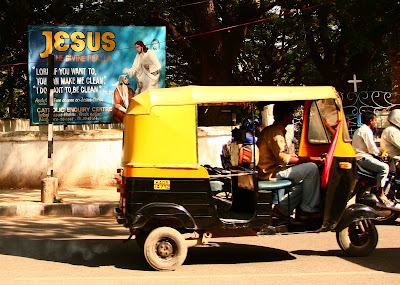
I arrived late on July 3rd, and spent the 4th getting accustomed to life in Delhi. It's a different world here and I've never been exposed to such poverty. None of the cars have seat belts! I'm convinced that Delhi has no official traffic laws, because driving here is madness. It's just a surge of cars, trucks, bicycles, pedestrians, 3-wheelers, rickshaws, and elephants going every which way they please. No lanes, just a rough definition of what side of the road cars are supposed to drive on. I'm not joking about the elephant thing either, I was on the highway and a man was riding one. All the traffic was just swerving around it. Did I mention it's hot here?! Oh my god.
It was very well attended -- Almost 45 students and faculty showed up. My first 1.5 hour talk was about Sana as an organization and our goals and next steps. The second 1.5 hour session was a technical overview of the platform for new developers.
The next 3 days were workshop sessions and about 20 students showed up for each.
 Sana is composed of 3 main parts, and each workshop focused on one part. I started each day at 10am with a 1 hour talk about the part we were focusing on that day and the various exercised and hands-on tasks I would have them do to get accustomed to the platform. We then split the group into about 4 or 5 groups and moved to a computer lab. The groups worked together to complete the tasks and myself, Sangeeta (a PhD student at IIIT-D that I've been working with over the Internet on Sana), and Amarjeet Singh (my host, professor at IIIT-D) all went between the groups and gave assistance. The workshops in general went 2 hours until 1pm, broke for 1 hour lunch, and then continued another 2 hours until 4 or 5pm, depending on when the students finished. The results of each workshop were very positive. We made each student group a mix of younger (1st/2nd year) and senior students, and students who had previous Sana experience so the younger students could learn from the older ones.
 During the workshops, a group of about 10 summer interns from IIIT-D who had already been working on extensions to the Sana platform were able to get hands-on tech support from me. This was a major win for their productivity because previously I had only interacted with these students over the Internet, and the going was very slow. Each one of them made major progress while I was available to help them for the 4 days. They are all working on some very cool extensions to Sana.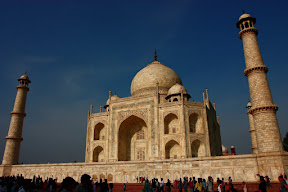
In my spare time I worked with Sangeeta to develop and complete a new feature where when the phones submit cases to our servers, the server can run an algorithm on the data to produce an automatic diagnosis. This is meant to supplement real diagnosis by a doctor, and can provide instant feedback to the health worker.
 Ankur Puri, a Sana team member working on a project with E-HealthPoints will use this in Punjab to do risk assessment for cardiovascular disease. A community health worker will go door to door in a village with a phone and fill out a survey. When they submit it to the server, the server instantly calculates their risk based on an algorithm on the supplied data, and returns their percentage risk for cardiovascular disease. If they are at high risk, the health worker can schedule them for an appointment at a clinic. Cardiovascular disease is special in that its a chronic disease that untreated, becomes acute. In many villages in Punjab, nobody even knows that they are at risk for CVD, let alone what CVD is. Raising awareness is first priority for improving health outcomes here, and this is a good first step to making that process affordable. This project in Punjab is extremely similar to our project in Bangalore, so this will help there as well.
It was incredibly exciting to work with these students hands-on because I could see the true power of open-source beginning to manifest itself in our project. These students are working on features that have been too low-priority for our team due to manpower issues, but despite cultural, geographical, and linguistic boundaries we can collaborate to improve the platform. As a result everyone using our software benefits. Furthermore, I formed personal relationships with these students, which will only help us have better communication remotely in the future.
 The workshops were essentially very successful all around. There are now 30 some students in India who have a good overall knowledge of how Sana works. A core of those students are already skilled at writing code for the platform. There were a number of 1st and 2nd year students in the group who got very valuable experience from the workshops. For example, they had no background with mobile application development coming in, but now they have the background necessary to start writing their own Android applications. They could sell these themselves in the Android market. Furthermore, it de-mystified the technology for many of them, which is important for their development as software engineers.
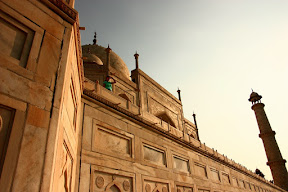
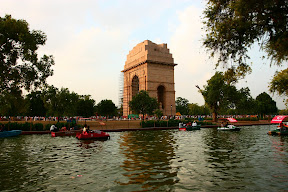
New student orientation was going on Friday, so on Friday and Saturday I entered full tourist mode. Friday I did a day-tour of Delhi and Saturday I did a day tour of Agra to see the Taj Mahal. I can't believe all the huge and breathtaking structures that exist around here. It seems that when these were being built, India had only an agrarian society and basically the only way for the emperors to keep their people employed and busy was to have them building new palaces year round.
On Monday of my second week, I flew to Bangalore.
 The weather here is a little more like Palo Alto, CA compared to the hades that Delhi was. Jeans and a t-shirt are very comfortable here. I arrived mid-day on Monday and Sidhant Jena, a fellow Sana team member, picked me up at the airport. We went straight to Narayana Hrudayalaya hospital to meet with the doctors with whom we will be running our oral cancer pilot.
The doctors at Narayana are working on a system they call Onconet, which is an agreement between Narayana and surrounding dental hospitals in which patients at the dental hospitals who are diagnosed with oral cancer via tissue cultures are referred to Narayana for treatment.
To make matters worse, Android does not currently support every language script in the world -- it only supports major langauges. This means it is not currently possible to display Kannada script on the phone. I immediately began work on extending Sana to support workarounds. After a quick hacking session, we are now able to record voice prompts for every question. I replaced some of the text with pictorial labels (e.g. forward/back arrows instead of "Next" and "Previous") and made the first voice prompt on screen play when you turn the page. These changes will hopefully make the application much more usable for the less-literate health workers.
Sidhant left to return to Delhi for a family function, and returned on Wednesday. That day, we met again with Dr. Moni because he had just spoken with a Gates-grant NGO who was very interested in learning more about our software. The most recent Gates grant request for proposals was exactly what we do, applications for healthcare on mobile phones, so we hope that working with this NGO will help increase the chances for the grant proposal we submitted. We scheduled a meeting and demo with them for July 26.
On Thursday, Sid and I had a big day. We started the morning at the Indian Institute of Science (IISc), which is a lot like MIT except only the science part whereas IIT is more the engineering part of MIT. They only offer post-graduate education, and tend to stay in the theoretical rather than applied.
Founded in 1909, IISc has a beautiful campus, secluded from the busy streets of Bangalore by tall walls and thick vegetation. In the first days, they took seeds from plants around the world and planted them everywhere in their campus. 100 years later, it's a melting pot of tree races. The African trees were like none I'd seen before.
At IISc, Sid and I met with Professor Gopi and his group in the Computer Automation Laboratory. We gave them a quick technical introduction to Sana and tried to find contact points at which it would make sense to work together. After our visit at IISc, we went to GE's India campus to meet Oswin Varghese, the pioneer of the portable ECG.
We showed him Sana and told him about what we are trying to do. He was very excited about working together and wanted to form a GE Partnership. At the veryleast, he was incredibly positive about getting his ECG systems working with Sana. We scheduled a meeting next week with more of their engineering team, and will demo it again then.
I am excited to imagine what a GE partnership could be if the very least is to support their devices. He said that they have had problems getting their ECG's out there. We think this is in part because it is not clear who needs the product. If a modern hospital uses it, they will already have an ECG machine that is non-portable. If a general practitioner uses it, they won't trust its output because they don't have the skills necessary to understand it, so instead of risking it they will send the patient to a specialist. The best use case is telemedicine, except they don't have a good way to get the data from rural areas to hospitals.

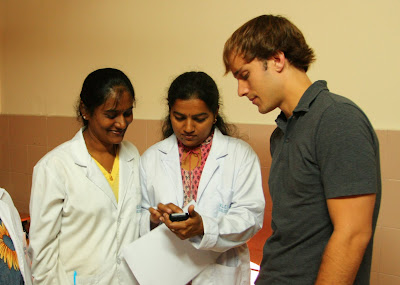

 It turns out that when they do rounds, they check on each patient using a form. They then call the doctor and tell her over the phone how each patient is doing. The paper forms are filed, but are often misplaced. This is a perfect